
Dispatch 11 / Written from 2035
Scenario confidence: high · Evidence cutoff: 12 August 2026
The Media Library Starts Making Decisions
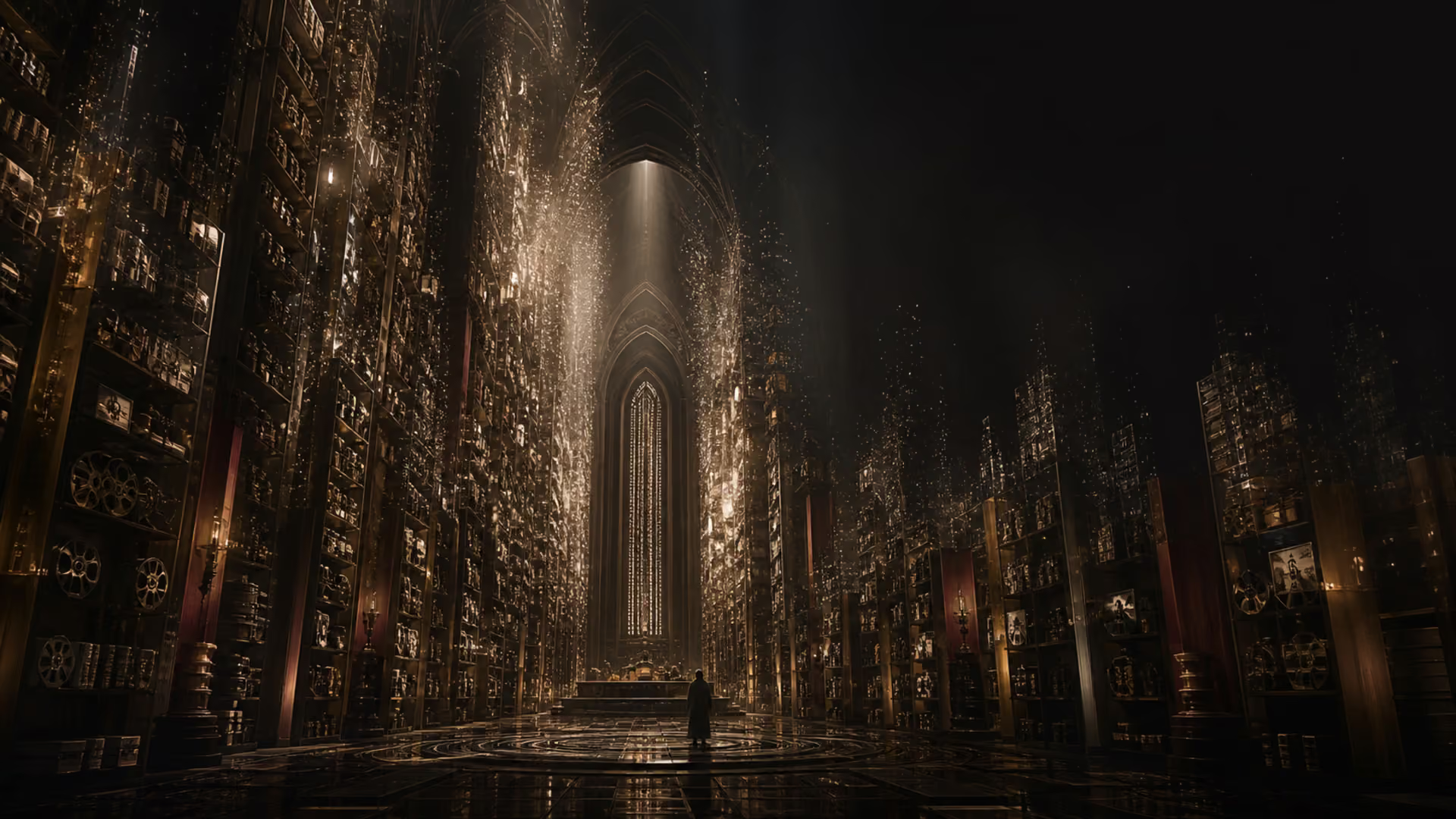
In 2035, the media library is no longer where campaigns go to sleep. It is where the institution remembers enough to act without repeating itself.
AI-generated conceptual scenario art, not documentary or forecast evidence.
The thesis
Media libraries will evolve into governed intelligence estates that can retrieve precedent, expose rights, assemble source material, identify repetition, and support new creation. Their value will depend less on model novelty than on preservation, description, relationships, permissions, and the editorial authority to decide what should remain dormant.
Evidence / 2026
Signals visible from here.
The Library of Congress frames digital stewardship across collection, preservation, access, and responsible experimentation with AI. Its preservation guidance is explicit that authentic bit-level copies are foundational but insufficient for future usability when formats, software, hardware, or rights become unavailable.
C2PA provides a structure for carrying ingredients and edit lineage with assets. Copyright guidance emphasizes the human expressive contribution within AI-assisted work. Together, these signals favor media libraries that preserve relationships and authorship rather than only final renditions.
Most commercial asset libraries still optimize filename search and campaign folders. They rarely preserve why an image was rejected, whether a performance may be synthesized, which source claim was later corrected, or what audience context made a reuse harmful.
Inference / 2035
A future history.
A media library answers institutional questions. It can surface every existing promise to a community, distinguish original capture from generated extension, show the rights remaining on a performance, and explain why a familiar visual motif was retired.
Models operate as temporary interpreters over preserved sources rather than becoming the media library itself. Curators can replace an embedding model, challenge a generated relationship, restrict sensitive collections, and reproduce the evidence behind a recommendation.
The media library participates in creation through bounded agents: locating underused work, proposing combinations grounded in documented context, warning about repetition, and preparing rights-ready source packets. Publication remains a new editorial act, not an automatic consequence of retrieval.
Interpretation
What changes for leaders and makers.
- Preservation, rights, metadata, and creative operations become one investment case. Without source integrity and permissions, an AI-ready media library is merely a faster ambiguity engine.
- Media libraries should retain significant refusals, corrections, and context—not every machine-generated intermediate. Selection policy is essential because infinite retention can increase risk while obscuring memory.
- Brands with deep bodies of work can build strategic differentiation when they preserve the conditions of use and invite reinterpretation rather than chasing superficial resemblance.
Recommendation / Now
Moves to make before the future hardens.
- 01Select one high-value collection and reconcile originals, derivatives, rights, contributors, dates, decisions, and known gaps before adding generative retrieval.
- 02Preserve fixity-checked originals, open or documented derivatives, technical metadata, and the software or instructions needed to render significant work.
- 03Separate source evidence from generated descriptions and inferred relationships; store confidence, model, date, reviewer, and correction record for each inference.
- 04Define collections that must not train models, must not leave a controlled environment, require cultural authority, or expire from operational access.
Open questions
What could change this conclusion.
Automated interpretation can canonize existing catalog bias and make missing communities less visible. Institutions must fund acquisition, repair, and participatory description—not only retrieval.
Long-term model and credential verification practices will change. Durable source preservation and exportable metadata are safer investments than dependence on one vendor’s intelligence layer.
Primary sources
The evidence beneath the scenario.
- Digital Strategy at the Library of CongressLibrary of Congress · Current in 2026
Describes digital stewardship as a continuing institutional capability and identifies responsible AI experimentation as one way to improve access and analysis.
- Bit Level Preservation and Long Term UsabilityLibrary of Congress · Current in 2026
Explains that authentic bit-level preservation is foundational but does not alone guarantee future usability, renderability, or rights-compatible access.
- C2PA Technical Specification 2.2Coalition for Content Provenance and Authenticity · Version 2.2
Defines signed, tamper-evident Content Credentials that bind provenance assertions to media while preserving the distinction between provenance and truth.
- Copyright and Artificial Intelligence, Part 2: CopyrightabilityUnited States Copyright Office · 2025-01
Concludes that generative-AI material can participate in copyrightable work when a human determines sufficient expressive elements, while prompts alone generally do not supply that authorship.