
Dispatch 01 / Written from 2035
Scenario confidence: high · Evidence cutoff: 12 August 2026
Direction After Infinite Production
By 2035, making another image will be trivial. Deciding what deserves to exist will be the scarce act.
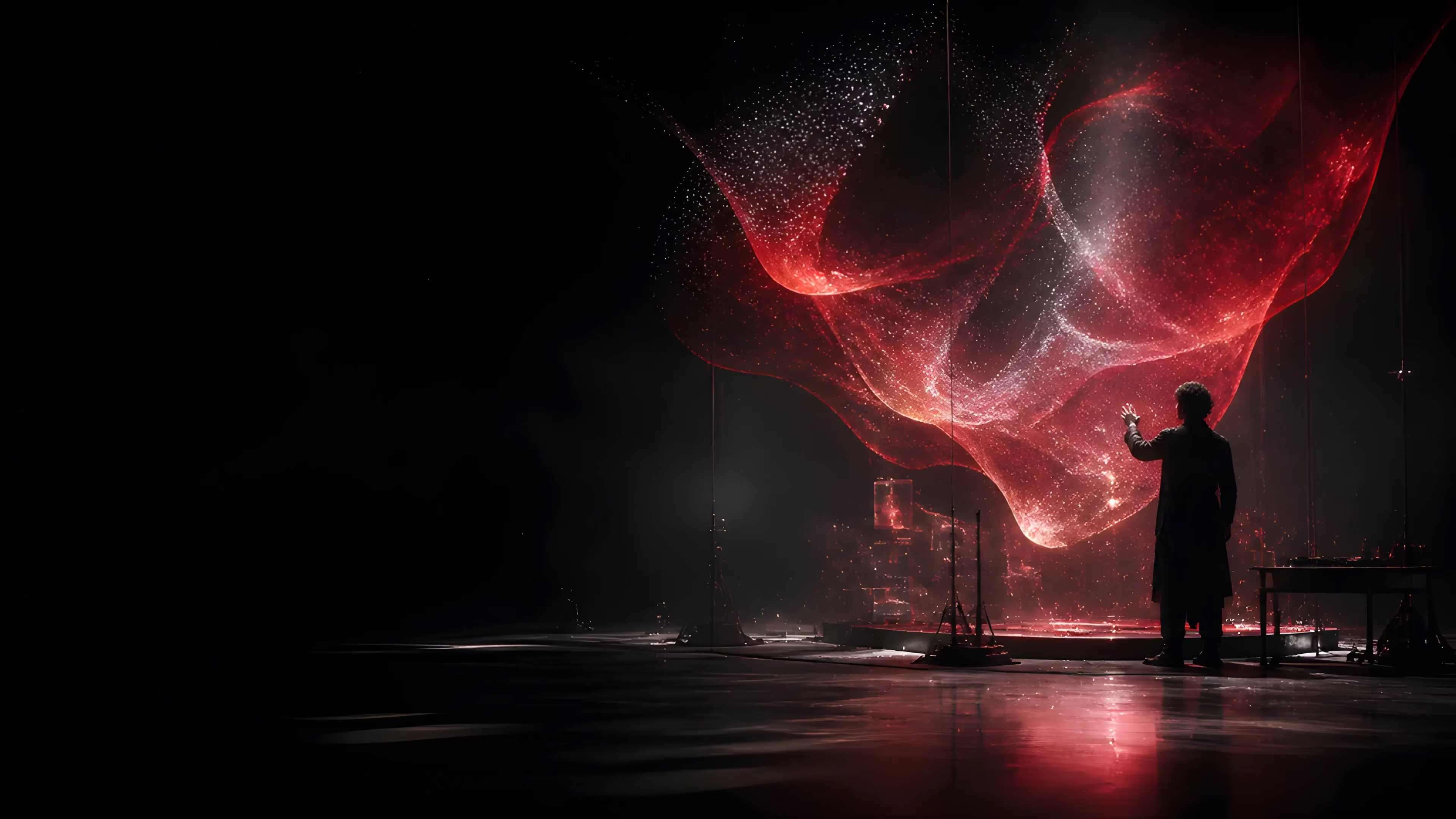
AI-generated conceptual scenario art, not documentary or forecast evidence.
The thesis
Creative direction is moving from supervision of execution to governance of possibility. As capable generation becomes inexpensive and ubiquitous, the valuable unit is no longer the isolated artifact; it is a legible sequence of choices that establishes intent, rejects plausible alternatives, preserves human authorship, and builds a coherent body of culture over time.
Evidence / 2026
Signals visible from here.
The 2025 AI Index documents a greater than 280-fold fall in the inference cost of a model at a fixed GPT-3.5-level benchmark between late 2022 and late 2024, alongside increasingly capable small models. That is not proof that every creative task is solved, but it is strong evidence that access to useful generation is broadening faster than traditional production structures can adapt.
The U.S. Copyright Office distinguishes assistance from authorship: AI use does not disqualify a work, but prompts alone generally do not establish protectable expression. Selection, arrangement, transformation, and other human expressive contributions therefore become operationally important, not merely philosophical.
The immediate bottleneck in ambitious teams is already shifting from first output to comparison, continuity, rights review, and the ability to explain why one treatment advances the idea while ninety-nine competent alternatives do not.
Inference / 2035
A future history.
A 2035 creative department begins with a direction model: a maintained corpus of references, exclusions, cultural context, audience promises, risk boundaries, and recorded decisions. Production systems can generate complete campaign worlds against that model, but nothing graduates merely because it is technically polished.
The Creative Director conducts possibility rather than requesting deliverables. They allocate novelty, control narrative distance, stage productive disagreement among human and machine collaborators, and leave a record of consequential decisions. Artists are commissioned for point of view, embodied knowledge, and the ability to break the system intelligently—not for being faster endpoints in a content queue.
The portfolio review resembles jurisprudence. Teams inspect what was proposed, what was refused, whose expression remains visible, how the work changes across contexts, and whether repetition is creating memory or merely volume. The most respected brands publish less than they could and make the restraint perceptible.
Interpretation
What changes for leaders and makers.
- A studio that sells production capacity will face relentless substitution. A studio that owns a recognizable theory of selection, a trusted critique practice, and a defensible authorship record can become more valuable as production abundance rises.
- CMOs should measure creative systems by accumulated distinction, learning velocity, and memory—not asset count. Procurement must stop equating efficiency with more variants and start buying accountable direction.
- Career ladders will need to reward editorial judgment, cultural research, systems literacy, and the ability to articulate rejection. Junior talent still needs craft practice; delegating every formative execution step to a model would hollow out the future directing class.
Recommendation / Now
Moves to make before the future hardens.
- 01Build a decision record that records references, rejected routes, critique, approvals, rights, and what the team learned after release.
- 02Separate generative throughput metrics from creative-quality metrics. Place a human decision and named owner at every irreversible publication gate.
- 03Commission artists before a visual language is settled, and contract for authorship, exploration, and knowledge transfer rather than only finished files.
- 04Train directors to work across models without allowing model defaults to become the house style. Run critiques where outputs are shown without tool labels, then inspect whether the rationale survives attribution.
Open questions
What could change this conclusion.
Generation costs may plateau, regulation may make some workflows expensive, and audiences may assign premium value to explicitly non-synthetic work. None of those outcomes restores scarcity to generic execution; each increases the value of declared intent and trustworthy authorship.
Copyright doctrine and contract practice will continue to vary by jurisdiction. Teams should treat current U.S. guidance as a signal for documentation, not as universal legal advice or a settled global boundary.
Primary sources
The evidence beneath the scenario.
- Artificial Intelligence Index Report 2025Stanford Institute for Human-Centered Artificial Intelligence · 2025-04
Documents rapid reductions in inference cost, improving small-model capability, and the narrowing performance gap between open-weight and closed models.
- Copyright and Artificial Intelligence, Part 2: CopyrightabilityUnited States Copyright Office · 2025-01
Concludes that generative-AI material can participate in copyrightable work when a human determines sufficient expressive elements, while prompts alone generally do not supply that authorship.
- Artificial Intelligence Risk Management Framework: Generative Artificial Intelligence ProfileNational Institute of Standards and Technology · 2024-07
Provides lifecycle actions for mapping, measuring, managing, and governing generative-AI risks rather than treating safety as a final review step.